An effective reading curriculum:
- Provides pupils with the knowledge they need for comprehension
- Ensures that pupils read a lot
- Is supported by the careful choice of increasingly challenging texts
‘Children learn to read so that they can read to learn!’
At Seascape Primary School, teaching children to become fluent readers with good understanding is our number one priority. From a child’s very first day in school, we aim to instil a lifelong love of reading. We believe that reading is fundamental to every child’s learning and the key to all knowledge.
Click the link below to learn more about reading at Seascape Primary School!
What reading looks like at Seascape Primary School
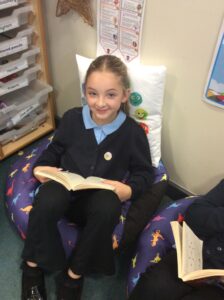
We put reading at the heart of our curriculum – not only teaching children how to read, but also developing a life-long love and enthusiasm for reading – so that each child understands the importance of reading within their learning journey.
We teach children to read so that they can read to learn!
Our principle aims from the National Curriculum for England are to ensure that all pupils:
- Read easily, fluently and with good understanding
- Develop the habit of reading widely and often, both for pleasure and to gather information
- Acquire a wide and rich vocabulary
- Appreciate our varied literary heritage

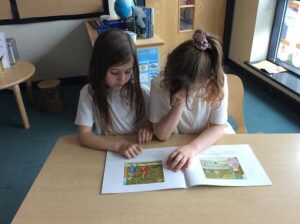
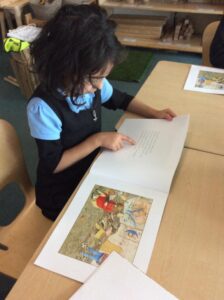
We know that future success is linked directly to a broad vocabulary, a love of reading and the ability to communicate effectively. Reading enables children to develop a richer vocabulary and an understanding of their world.
At Seascape Primary School, we believe all children should have the opportunity to be confident, fluent readers who can comprehend a range of age-appropriate texts. We want pupils to develop a love of reading, a good knowledge of a range of authors, and a greater understanding of the world in which they live, through the knowledge they gain from texts. By the end of their time at Seascape, it is our intention that all children should be able to read fluently and with confidence, in any subject in their forthcoming secondary education. We understand the importance of parents and carers in supporting their children to develop both word reading and comprehension skills.
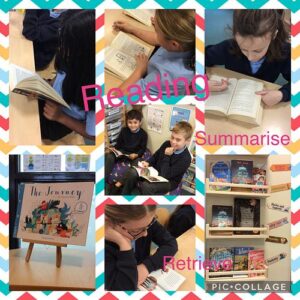
Reading Schemes used across school:
- Read, Write, Inc. (DFE Approved)
- Read, Write, Inc. reading material (Decodable reading material linked to phonics scheme)
- Collins Big Cat (Decodable reading material linked to phonics scheme/ progression), Guided Reading, 1:1 Teacher/ Pupil reading, Phonics Support, Intervention for struggling readers
- CLPE Power of Reading
- FFT RAP
- Speech and Language support via Let’s Talk (weekly) and SALT service (periodically) for those pupils identified as requiring additional support
How school ensures that reading is prioritised and that children develop a life-long love of reading:
- Reading is prioritised across school so that every child learns to read with age-appropriate fluency and understanding as a means of enhancing access to learning across the curriculum.
- A priority is to move children from ‘learning to read’ to ‘reading to learn’ so that reading skills can be applied in support of wider learning and vocabulary development.
- Timetables for each Team clearly reflect this priority with dedicated time for reading (reading 1:1, comprehension, story time, children sharing writing, comprehension, guided reading, songs, rhymes).
- Every Team highlights core teaching sessions of fluency to involve 1:1 reading and whole-class reading comprehension alongside a carousel of guided reading learning tasks. This provides children with opportunities to develop automaticity to read with accuracy and speed in determining the meaning of a text.
- Every pupil, across school, is read with on a 1:1 basis AT LEAST three times per week with a skilled adult. This provides effective opportunities to focus on the assessment of individual CD targets, word recognition, language comprehension and identification of specific gaps in reading skills.
- The lowest 20% of readers across school read 1:1 with a skilled adult 3 times/ week, and are involved in effective daily reading interventions to enable rapid ‘catch up’ .
- Every pupil has exposure to some form of reading every day.
- Decodable reading material for early readers reflect the Grapheme-Phoneme Correspondences (GPCs) which have been taught and those common exception words taught at any point in time. These books follow the sequence of phonics teaching and the SSP in school to ensure fidelity across this provision.
- Reading records evidence 1:1 reading in school separate to reading at home – this provides greater clarity and more precise guidance for staff in relation to a pupil’s progress and targets for improvement, through ongoing evaluation of reading progress and judgements of a skilled adult.
- Collins reading scheme is used in school for 1:1 reading sessions. Additional material from the scheme has also been purchased to support guided reading sessions and phonics (decodable material).
- CLPE is used as a core element to the planning and delivery of English in each Team. Each half-term, every Team focuses on a high-quality text to plan and deliver a wide range of curriculum learning tasks, including reading and writing opportunities. Texts are chosen based on a range of factors including the CLPE Progression and Sequencing plan, a review of pupil/ cohort targets and areas for improvement and an analysis of previously chosen texts and impact on learning. Teaching sequences are adapted to ensure that targeted curriculum objectives are focused on across reading and writing opportunities and (where relevant and purposeful) connections are made with other curriculum subject areas such as science, DT, computing etc.
- High-quality texts are used to compliment learning across curriculum subjects and provide increased opportunities for children to apply their reading skills in context so that they are able to read to learn in order to support and accelerate development of key subject-specific knowledge, skills and vocabulary.
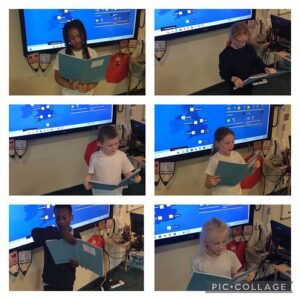
CLPE Power of Reading
CLPE is utilised as the core mechanism by which to plan and deliver a reading-rich, book-led curriculum, with high quality text-types carefully sequenced into a whole-school progression plan covering a range of reading genres.
This ensures that children experience a wide range of text-types through enriching high-quality book choices, aimed at also promoting pupil’s knowledge and understanding of diversity, inclusion, social responsibility, the causes of social disadvantage and British Values.
Text-type progression and sequencing planning also provides children with a wide range of opportunities to enhance their writing skills.
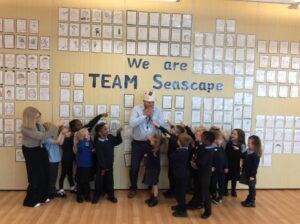
Team Rosen have been doing lots of work about our English text ‘I Want My Hat Back’. We have designed and made our own hats but when we came in to school yesterday one of them was missing!
The children then noticed some clues so we began to investigate the mystery of the stolen hat.
A glasses case was the first clue – Harley read the words on the case ‘TERRIFIC TEACHER’. We were all shocked a teacher could be the thief.
The next clue was a sticker where the hat had been. Junior said, “ It’s a head teachers sticker”. Everyone said it must be Mr Christie!!
We went up to find out. Marnie said to Mr Christie, “ Have you seen a hat?” Mr Christie said, “A hat? I haven’t seen a hat!”
“YOU STOLE MY HAT!” said Bume.
We all had a lot of fun and a big thank you to Mr C for playing along with the ruse!
Phonics
Please view our Phonics Slideshow below:


Adobe Reader
You may need a product like Adobe Reader (free download) to view our PDF documents on our website.